
For general contractors working on large-scale projects, the tendering phase is often the most stressful part of preconstruction. You are managing dozens of trades, hundreds of documents, and a constant stream of emails. Procore tender management provides a structured way to handle this chaos, but simply using the tool isn't enough to guarantee a good outcome.
To truly win at tendering, you need to move beyond just organizing files. You need to turn your tender data into intelligence. In this guide, we will look at how to optimize your Procore tendering workflow and how AI is changing the way teams evaluate subcontractor proposals.
What is Procore tender management?
Procore tender management is a dedicated module designed to centralize the process of inviting subcontractors to bid on a project. It replaces the old-fashioned method of sending individual emails and tracking responses in a spreadsheet.
Inside Procore, you create "tender packages" for specific trades, such as electrical or plumbing. Each package contains the drawings, specifications, and schedule relevant to that trade. Subcontractors receive an invitation, log into a secure portal, and submit their pricing and qualifications directly. This creates a single source of truth for all preconstruction data, ensuring that nothing gets lost in a personal inbox.
Bidding vs. Tendering: What is the difference?
While the terms are often used interchangeably, there are subtle differences depending on where you are located. In the United States, "bidding" is the standard term. In the UK, Australia, and parts of Europe, "tendering" is more common.
Beyond the name, tendering often implies a more formal, multi-stage process. A "tender" is frequently a firm offer that, if accepted, forms a legally binding contract. Bidding can sometimes be more informal, involving several rounds of negotiation before a final price is set. Regardless of the terminology, the goal remains the same: finding the most qualified partner at the right price.
Common bottlenecks in the tendering process
Even with a tool like Procore, bottlenecks can still slow down your awards. One of the biggest issues is the lack of standardization. Every subcontractor has their own way of presenting a proposal. Some use detailed line items, while others provide a single "lump sum" price with a list of exclusions buried in a PDF.
Manually extracting this data into a comparison sheet is a massive time sink. As a recent industry report on Inventive AI highlights, the sheer volume of tenders and the increasing complexity of compliance requirements in 2026 have made manual workflows nearly impossible to maintain without risking errors.
Another bottleneck is the "information gap." If a subcontractor forgets to include a specific scope item, like site cleanup or permit fees, it might not be noticed until after the contract is signed. These hidden gaps lead to change orders that eat into your profit margins.
How to set up Procore tender packages for success
To avoid these bottlenecks, you need to set up your tender packages correctly from day one. Here are three best practices for 2026:
- Use Tender Template Collections: Procore now allows you to create collections of templates. Instead of building every package from scratch, use standardized forms that require subcontractors to provide data in a specific format.
- Clean Up Your Cost Codes: Ensure your project cost codes are aligned with your company standards before you send out invitations. This makes it much easier to track costs once the project moves into the construction phase.
- Set Clear Deadlines and RFI Cut-offs: Use the "Correspondence" tab in Procore to manage questions. Setting a hard deadline for RFIs ensures you aren't answering basic scope questions two hours before the tender closes.
Using AI to automate tender leveling
The most significant advancement in tendering recently is the use of AI to automate "tender leveling" (also known as bid leveling). Traditionally, an estimator would spend days typing data from PDF proposals into an Excel sheet to compare them side-by-side.
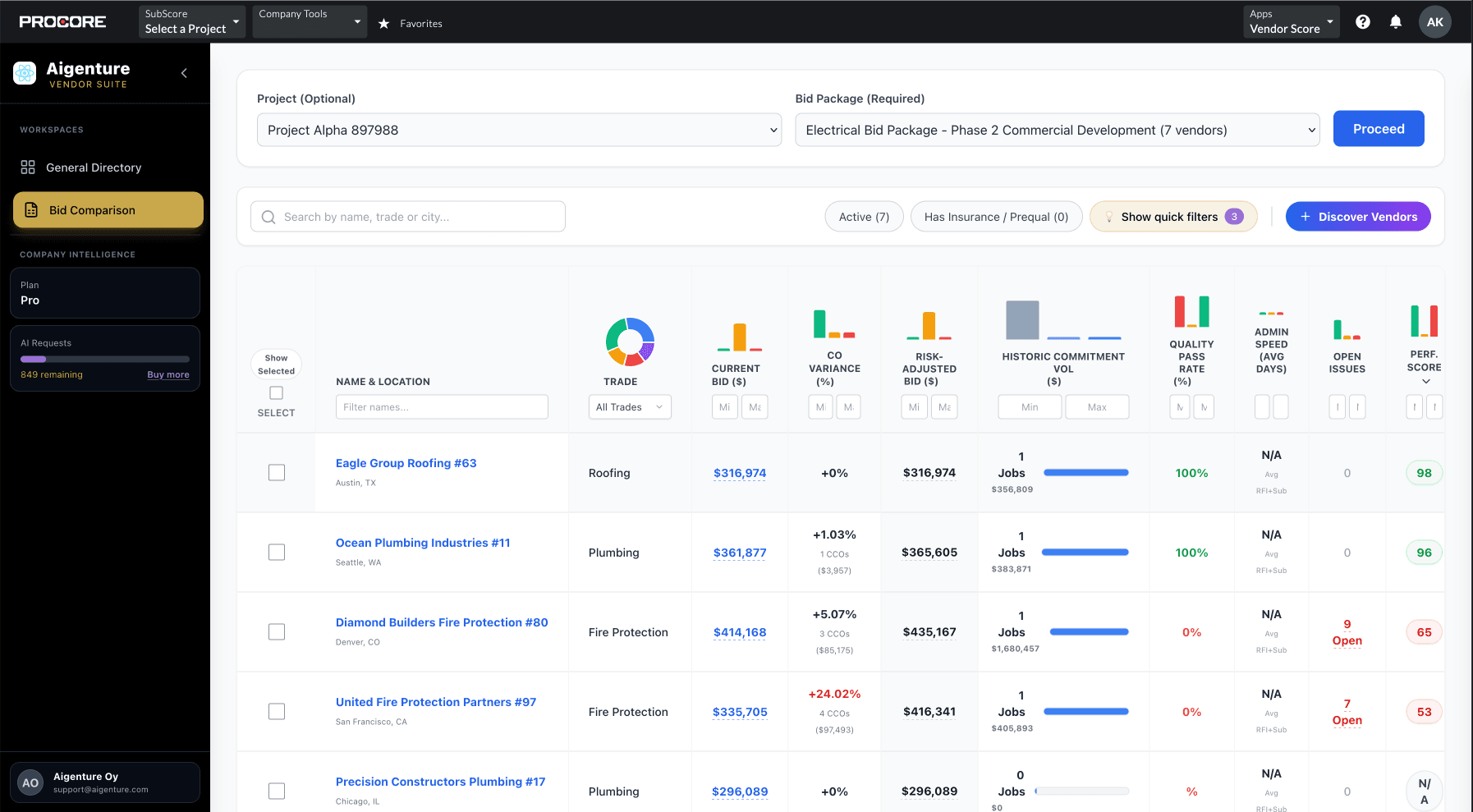
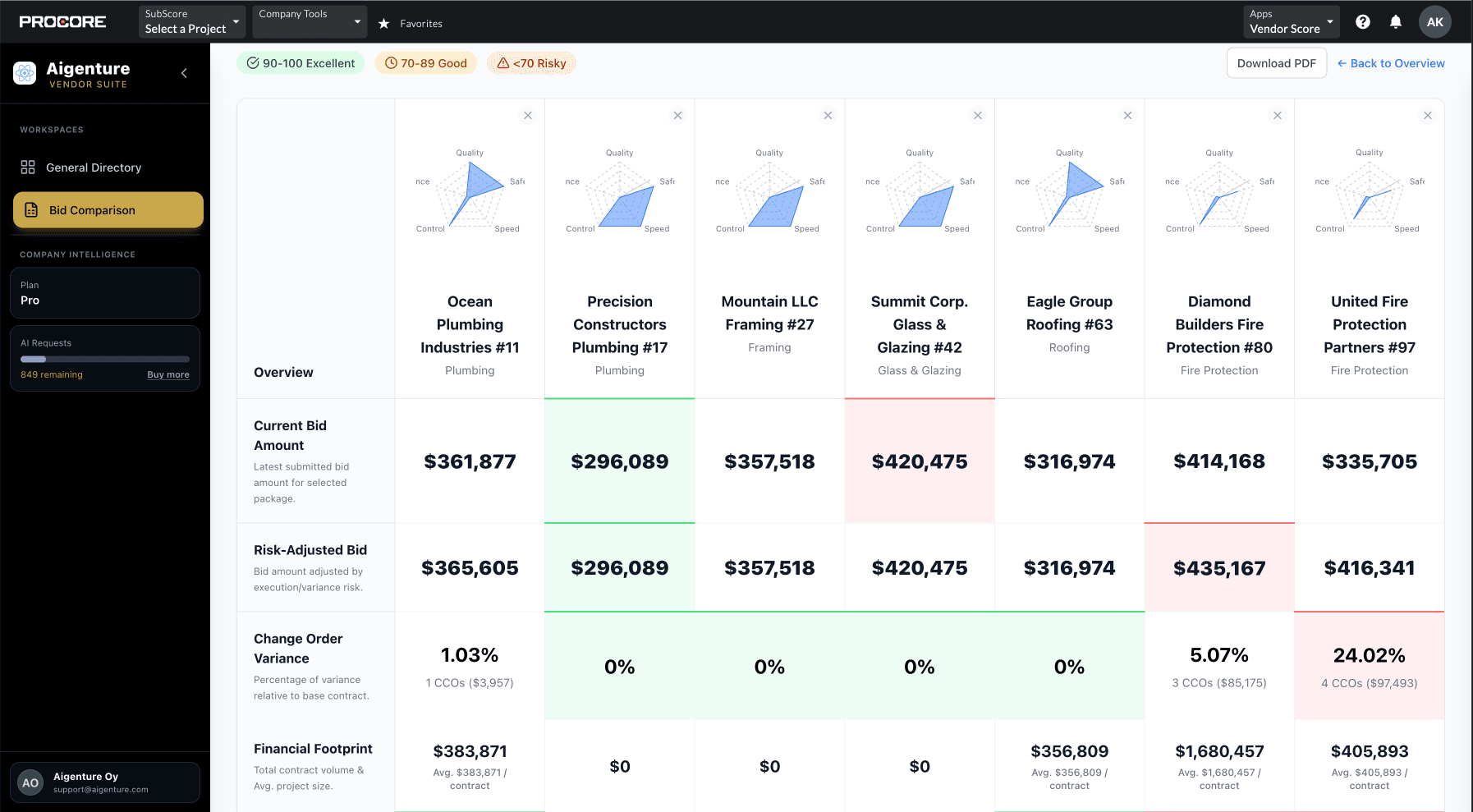
AI-powered tools like Aigenture now do this work instantly. By integrating directly with your Procore tender packages, the AI can read unstructured PDF proposals, identify scope items, and normalize the data. This allows you to see an "apples-to-apples" comparison of every subcontractor in seconds.
Research by Mahmoudi et al. (2024) found that using advanced matching models and multi-criteria decision-making can significantly improve the "fit" between project requirements and subcontractor capabilities, reducing the risk of project delays. By automating the data entry, your team can spend more time on high-value tasks, like negotiating better terms or vetting the quality of the work.
Evaluating subcontractor risk during the tender phase
The lowest price is rarely the best value. To protect your project, you must evaluate the risk associated with each subcontractor. This is where "tender analysis" goes deeper than just looking at the bottom line.
You should look at: * Financial Stability: Does the subcontractor have the cash flow to handle a project of this size? * Safety Records: What is their EMR rating? Have they had recent OSHA violations? * Field Performance: How have they performed on your past projects? Did they hit their milestones, or were they always behind schedule?
Aigenture helps by pulling historical field data directly from your Procore project history. It connects the dots between a subcontractor's bid and their actual performance on previous jobs, such as their inspection pass rate or the number of open observations they typically have.
Conclusion: Moving to intelligent tender management
Procore tender management is a powerful foundation, but the real competitive advantage comes from how you use the data inside it. By moving away from manual spreadsheets and adopting AI-driven insights, you can award contracts 10x faster and with much higher confidence.
If you are still leveling tenders by hand, you are leaving your project's success to chance. Tools like Aigenture turn your Procore data into a decision engine, helping you spot risks and find the best trade partners for every job.
Ready to see how AI can transform your tendering process? Start a 30-day Free Trial or Contact Us to learn more.
References
Mahmoudi, A., et al. (2024). "A Matching Model for Construction Subcontractor Selection in Engineering Bid Decisions Using Ordinal Priority Approach." Journal of Asian Architecture and Building Engineering.
"Tender Management: Process, Software, Best Practices (2026)." Inventive AI.
"A Machine-Learning-Based Framework for Contractor Selection and Order Allocation in Public Construction Projects." (2024). Annals of Operations Research.