
Choosing a subcontractor based on the lowest bid is a common practice, but it is often a risky one. A low price on paper can quickly turn into a high cost in the field if the vendor has a history of delays, safety violations, or poor quality. To build a profitable project, you need to know more than just the number at the bottom of a proposal. You need to understand how that subcontractor has performed on past jobs.
Tracking historical performance allows preconstruction teams to move from guesswork to data-driven decision making. By looking at a vendor's track record, you can spot red flags before they become project-ending problems.
Why historical performance is the best predictor of project success
In construction, the past often repeats itself. A subcontractor who consistently finishes ahead of schedule is likely to do so again. Conversely, a firm with a history of change order disputes will probably bring those same habits to your next project.
Research by Al-Sabaeei et al. (2025) highlights the importance of an objective framework for evaluating subcontractor performance. Their study proposes a Performance Index (PI) that measures vendors across seven key areas: time, cost, quality, safety, resources, general contractor satisfaction, and leadership. By quantifying these factors, general contractors can minimize subjective bias and make award decisions based on actual results rather than just relationships or gut feelings.
When you ignore this data, you take on unnecessary risk. Subcontractors often perform 40% to 90% of the total work on a project. If a major trade partner fails to deliver, the entire project schedule can collapse.
Key metrics for evaluating subcontractor performance
To track performance effectively, you need to know which numbers actually matter. Not every data point is equal. Focus on the metrics that have the biggest impact on your bottom line and project timeline.
As a recent industry report on the Procore Jobsite highlights, maintaining data integrity is the first step toward gaining these insights. The report suggests tracking five key areas:
- Schedule Adherence: How often does the subcontractor meet their milestones? Look for "lag rates" or the difference between planned and actual completion dates.
- Quality and Rework: Track the number of failed inspections and the speed of punch list completion. High rework rates are a hidden cost that eats into your contingency.
- Safety Records: Monitor safety observations and incident rates. A subcontractor with poor safety habits increases your insurance risk and can lead to costly site shutdowns.
- Financial Stability: Look at the variance between the original contract value and the final cost. Frequent, aggressive change orders are a sign of a subcontractor who may be underbidding to win work.
- Manpower Reliability: Use daily logs to see if the subcontractor consistently provides the crew size they promised.
The challenge: Data is trapped in the field
The biggest hurdle to tracking performance is not a lack of data. It is where that data lives. Most general contractors have mountains of information stored in Procore, but it is often "trapped" in the field.
Project managers and superintendents see the daily reality of subcontractor performance. They fill out daily logs, conduct inspections, and record safety observations. However, this information rarely makes it back to the preconstruction team in a usable format.
When an estimator is leveling bids for a new project, they often rely on anecdotal feedback. They might call a project manager to ask, "How did this electrical sub do on the last job?" The answer is usually subjective and based on the most recent interaction, not a comprehensive look at the data. This disconnect leads to repeating the same hiring mistakes across different projects.
How to collect performance data inside Procore
If you use Procore, you already have the tools to collect this data. The key is consistency across all your project teams. You need a digital paper trail that follows every subcontractor from project to project.
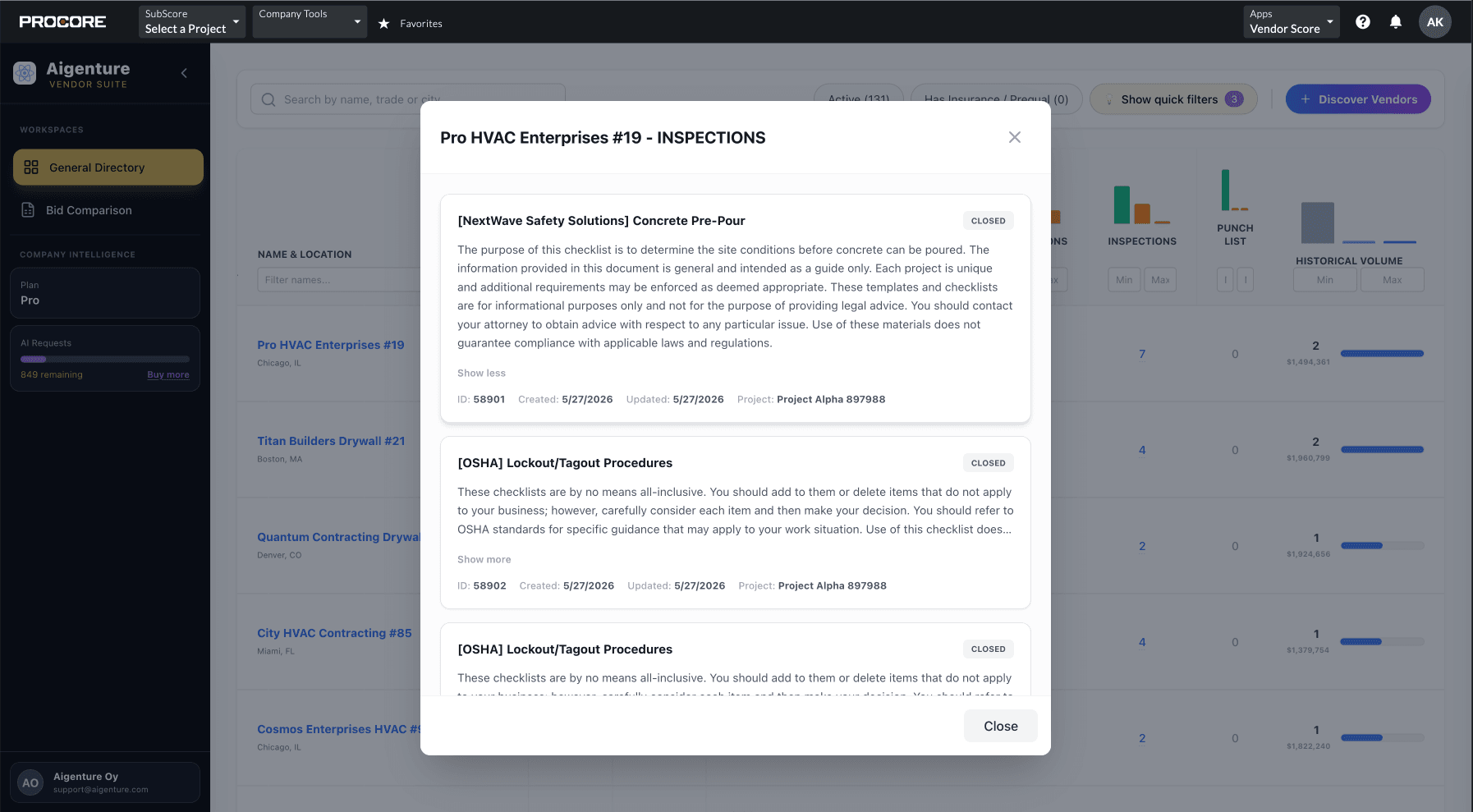
- Inspections and Observations: Use these modules to track quality and safety. If a subcontractor fails an inspection, it should be recorded every time. Over several projects, this creates a clear picture of their attention to detail.
- Daily Logs: These are vital for tracking manpower. If a sub is supposed to have 10 people on site but only shows up with 4, that needs to be documented. This data helps you verify if a sub has the capacity to handle your next big project.
- Submittals and RFIs: Track how long it takes for a subcontractor to respond to requests for information or to turn around submittals. Slow administrative work in the office often signals upcoming delays in the field.
Turning Procore data into vendor intelligence with AI
Collecting data is only half the battle. The real value comes from analyzing it. Manually reviewing thousands of daily logs and inspection reports for every bidder is impossible for a busy preconstruction team. This is where artificial intelligence changes the game.
AI can scan your entire Procore history in seconds. It can identify trends that a human might miss, such as a subcontractor whose performance starts to dip every time they take on more than three concurrent projects. By connecting field outcomes directly to the bidding process, you create a "decision engine" for your firm.
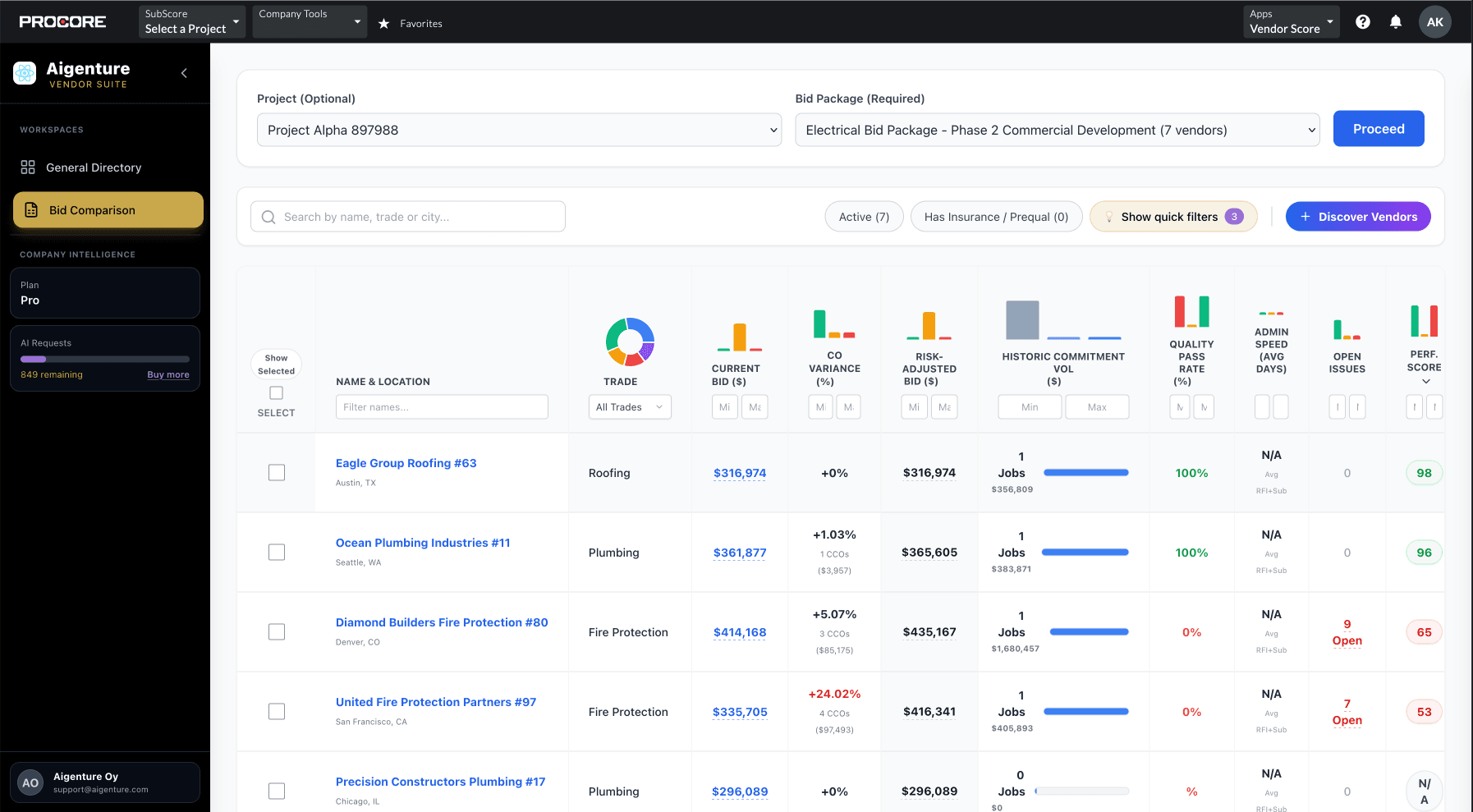
Instead of just looking at a bid price, you can look at a "risk-adjusted" price. If Subcontractor A bids $100,000 but has a history of 15% change order growth, their real cost is $115,000. If Subcontractor B bids $110,000 but has 0% variance, they are actually the cheaper and safer choice.
How Aigenture automates performance tracking
Aigenture lives natively inside Procore to bridge the gap between the field and preconstruction. It automatically pulls your historical project data and turns it into actionable intelligence during the bid leveling process.
When you open a bid package, Aigenture shows you a summary of how each bidder has performed on your past projects. You can see their historical change order percentages, quality pass rates, and even their average manpower levels without leaving the bidding tool.
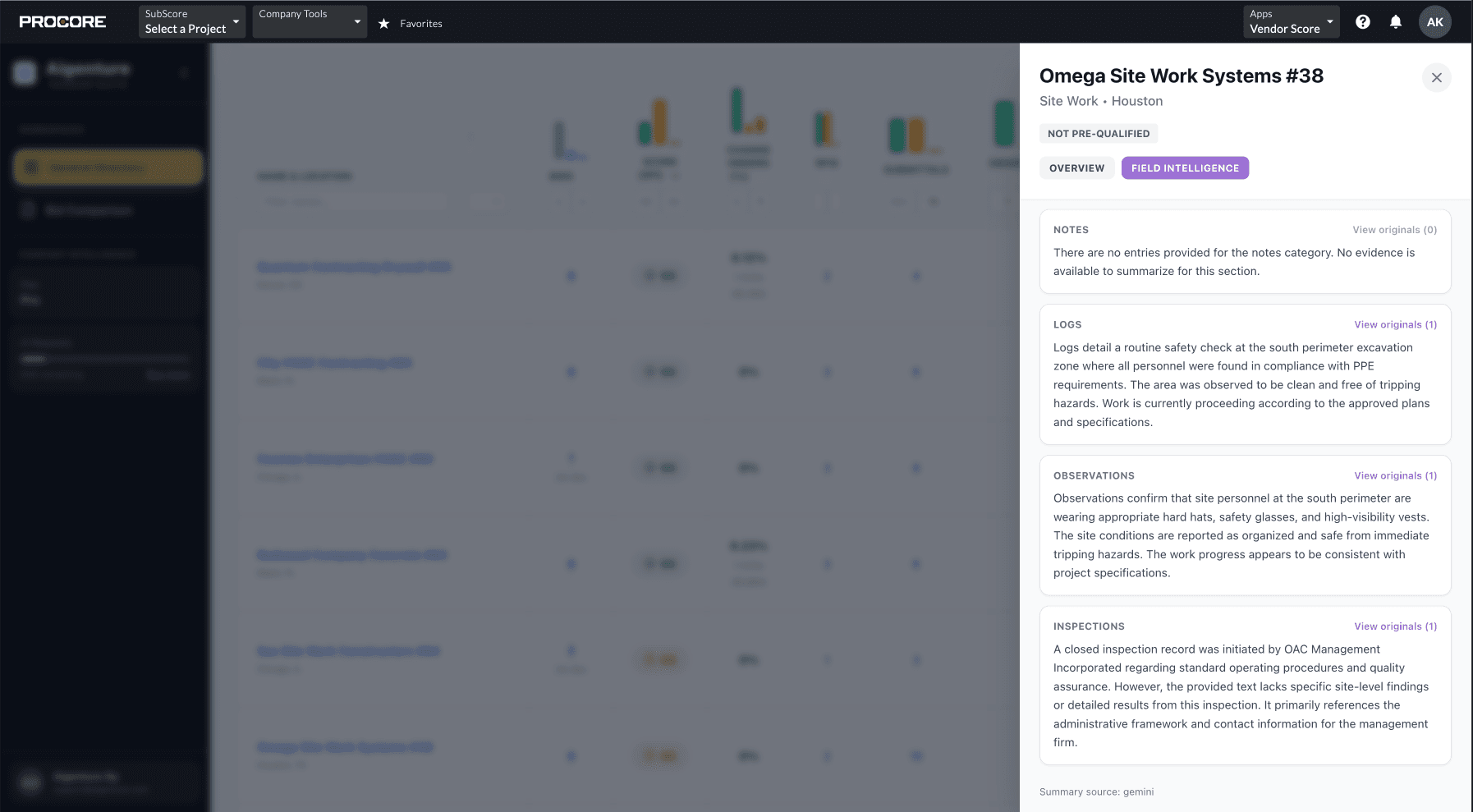
The "Field Intelligence" feature provides a generated summary of notes, logs, and observations. This allows estimators to quickly understand the context behind the numbers. If a sub had a low quality score on one project, the AI can explain if it was a one-time issue or a recurring pattern.
By using these tools, you can filter your directory to find the best trade partners for a specific job. You can search for subcontractors with the "highest inspections pass rate" or "lowest financial variance" in a specific trade and location. This ensures you are always inviting the most reliable vendors to the table.
Conclusion: Making data-driven awards
Tracking subcontractor performance is no longer an optional "extra" for general contractors. In a market with tight margins and labor shortages, you cannot afford to hire the wrong team.
By centralizing your field data and using AI to extract insights, you turn your Procore history into a competitive advantage. You reduce the risk of defaults, minimize change orders, and build better relationships with your top-performing partners.
Aigenture helps you unlock the value of the data you already have. If you want to see how AI can transform your bid evaluations and risk management, you can start a 30-day free trial today. No credit card is required, and it installs directly into your Procore environment. View Plans or Contact Us to learn more.
References
Al-Sabaeei, A. M., et al. (2025). "A Systematic and Objective Framework for Evaluating Subcontractor Performance." Buildings.
"Using Data to Track Subcontractors' Progress: 5 Keys to Success." Procore Jobsite.
"Performance Metrics for Enhanced Oversight." Procore Jobsite.