
For years, preconstruction teams have treated bidding as a clerical task. You send out invitations, collect PDFs, and type numbers into a spreadsheet. This process manages the data, but it does not understand it. In 2026, the industry is moving away from simple record-keeping toward what experts call predictive intelligence.
Procore bid insights represent this shift. Instead of just storing a subcontractor's price, you can now extract deep intelligence from every proposal. This means seeing the risks, patterns, and opportunities hidden inside the documents before you award a contract.
What are Procore bid insights?
Procore bid insights are the actionable pieces of information you get when you analyze your bidding data. Most teams have a gold mine of information sitting in their Procore account, but it is often trapped in unstructured PDF files.
When you move beyond simple data entry, you start to see bid data as your most valuable asset. You are not just looking at what a job costs today. You are looking at how that cost compares to your historical averages and how it fits into the current market.
Bid management vs. Bid intelligence: What is the difference?
It is easy to confuse these two terms, but they serve different purposes. Bid management is about organization and communication. It involves creating bid packages, sending invitations, and making sure subcontractors submit their files on time. It is the plumbing of the preconstruction process.
Bid intelligence is about finding patterns and spotting risks. It asks questions like: * Why is this electrical bid 20% lower than the others? * Does this subcontractor have a history of high change orders on similar projects? * Is there a specific scope item that everyone seems to be missing?
As a recent industry report on Procore.com highlights, the construction sector is currently in a "hard pivot" from mere digitization to true intelligence. You need management to stay organized, but you need intelligence to stay competitive and protect your margins.
Key metrics to track in your bidding process
To get real insights, you need to track specific metrics across your trades.
Bid spread
This is the range between the highest and lowest bids for a single trade. A wide spread often indicates that the scope of work was not clear. If one bid is $100,000 and another is $250,000, they are likely not bidding on the same thing.
Scope coverage
You must ensure every line item in your estimate is accounted for in the subcontractor proposals. Missing scope is the leading cause of budget overruns once the project hits the field.
Historical variance
Compare current bids to what you paid for similar work on past projects. If prices are spiking in a specific trade, you need to know if it is a market trend or a specific issue with your current bidders.
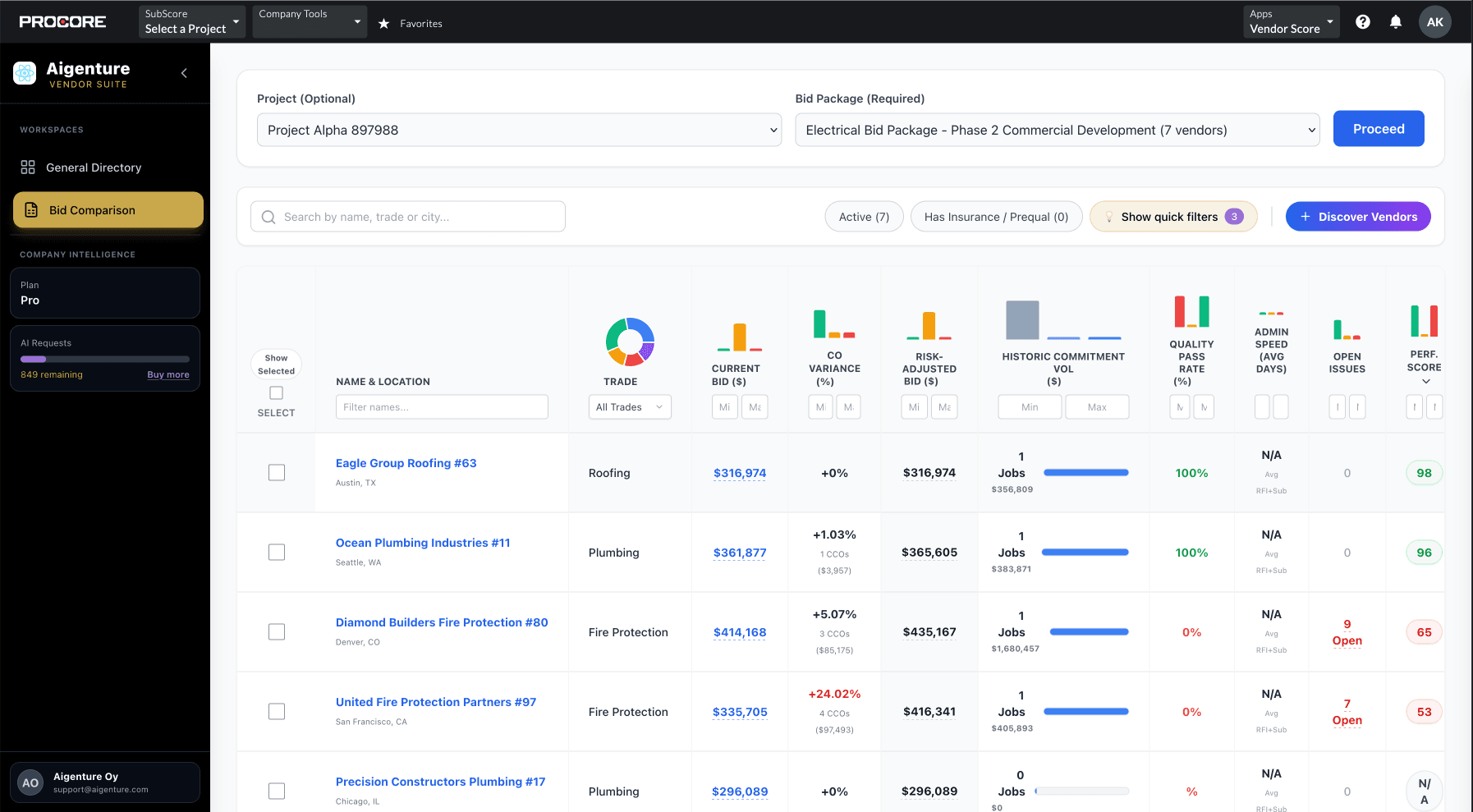
How AI extracts insights from unstructured PDF proposals
The biggest hurdle to getting bid insights has always been the format of the data. Every subcontractor has their own proposal template. Some send detailed breakdowns, while others send a single page with a total price.
Modern AI tools now solve this by reading these PDFs like a human estimator would. Machine learning models identify scope items, exclusions, and unit prices automatically. This allows you to normalize the data instantly. You can see a side-by-side comparison of every bidder without spending hours on manual data entry.
Research by Ashtiyani et al. (2025) found that AI-based frameworks for coordinating subcontractors significantly improve the ability to monitor productivity and support proactive decision-making. By automating the data extraction, you free up your estimators to actually estimate rather than just type.
Spotting hidden risks with data-driven insights
Data-driven insights help you find the "too good to be true" bids that lead to project delays. A low bid is only a win if the subcontractor can actually perform the work for that price.
By connecting your bidding data to your historical field performance, you can see which vendors consistently deliver quality work. If a subcontractor has a high "inspections fail rate" in your Procore history, their low bid might actually be the most expensive option in the long run. You can learn more about this in our guide on how to track subcontractor historical performance.
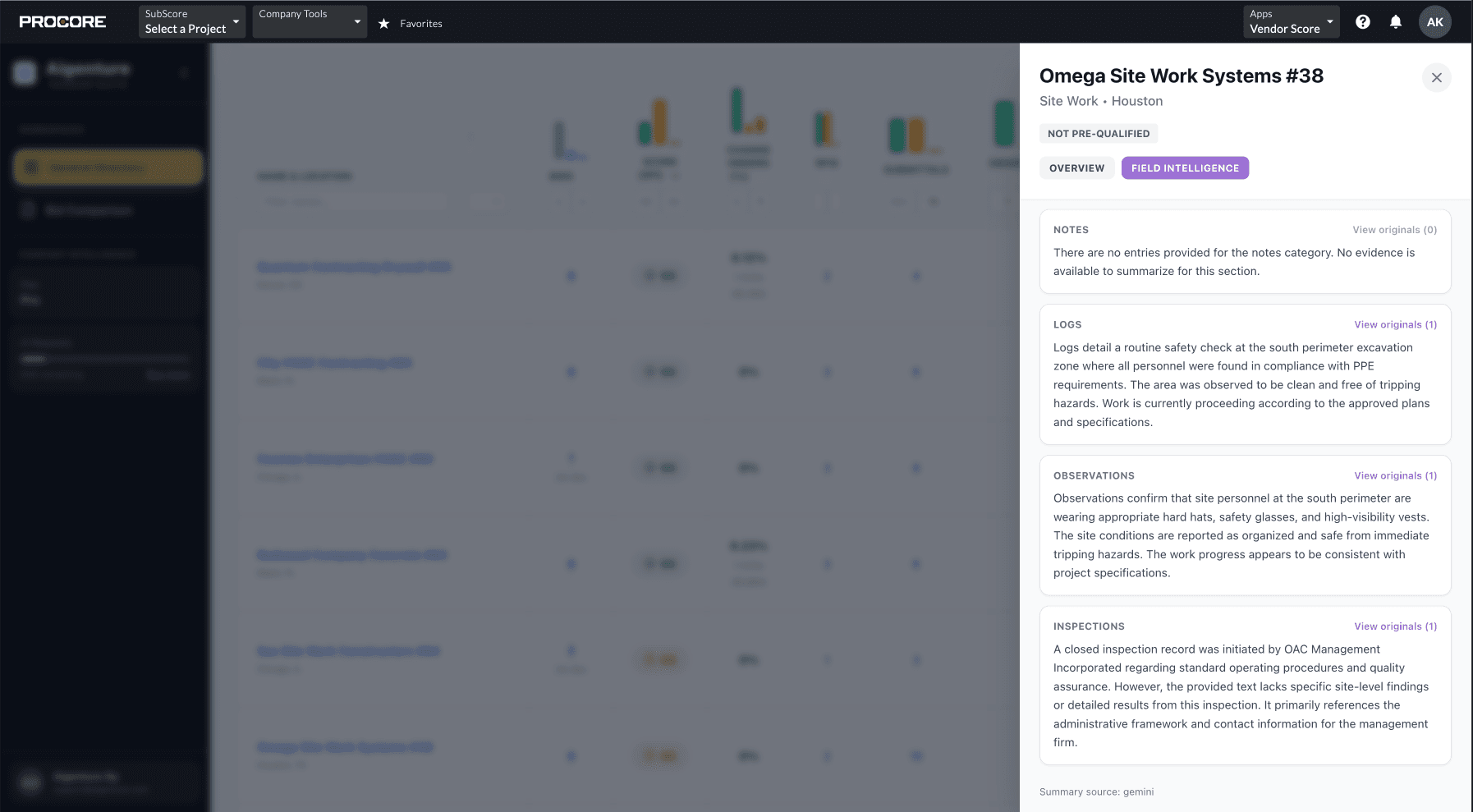
How Aigenture provides native bid insights inside Procore
Aigenture turns your Procore history into a decision engine. Because it lives directly inside your Procore environment, there is no need to export data to Excel or log into a separate platform.
We help you get 10x faster evaluations by automating the normalization of every bid. Our AI identifies scope gaps and price discrepancies the moment a proposal is uploaded. This means you can spot a missing backup generator or an excluded permit fee before you even start the leveling meeting.
By using Aigenture, you are not just managing bids. You are extracting the intelligence needed to make better award decisions. If you want to see how this works with your own data, you can start a 30-day free trial today.
References
Ashtiyani, F. M., Karimi Gavareshki, M. H., & Gheidar-Kheljani, J. (2025). "AI-based multi-layer framework for monitoring productivity and coordinating subcontractors in construction projects." International Journal of Construction Management.
"5 Construction Tech Trends in 2026 That Will Drive True Transformation." Procore Blog.
"The 2026 ROI Report: General Contractor Edition." Procore Resources.