
Managing subcontractor bids is often the most chaotic part of preconstruction. Between chasing down proposals, digging through PDF attachments, and trying to spot scope gaps in a spreadsheet, the process can take weeks.
For general contractors using Procore, the native bidding tools provide a strong foundation. But in 2026, simply "managing" bids isn't enough. You need to be able to evaluate them instantly and make award decisions based on data, not just the lowest number.
What is Procore bid management?
Procore bid management is the process of organizing, soliciting, and evaluating subcontractor proposals within the Procore platform. It centralizes everything that used to happen in fragmented email threads.
The core of this workflow is the Bid Package. This is where you group your drawings, specifications, and instructions for a specific trade. By using the Procore bidding tool, you create a single location where subcontractors can download files and submit their pricing. This ensures that everyone is working from the same set of documents, which is the first step toward a fair comparison.
The challenges of traditional bid management
Even with a centralized tool, preconstruction teams still face significant hurdles. The most common issue is the "PDF bottleneck." Subcontractors submit their bids in different formats, with varying levels of detail.
One vendor might include cleanup in their price, while another lists it as an exclusion. Spotting these discrepancies manually is exhausting. It leads to: * Manual data entry errors: Typing numbers from a PDF into a leveling sheet is a recipe for mistakes. * Hidden scope gaps: Missing a $50,000 exclusion can ruin a project's profitability before it even starts. * Slow award cycles: If it takes two weeks to level a trade, you risk losing your preferred subcontractor to another job.
Research by Turskis et al. (2019) highlights that automated multi-criteria decision-making models significantly reduce the time required for subcontractor selection while improving the objectivity of the award process. Without these automated tools, estimators are often forced to make "gut feel" decisions just to keep the schedule moving.
How to set up your Procore bidding workflow for success
To get the most out of Procore, you need a standardized setup. Start by creating clear bid forms. Instead of just asking for a lump sum, break down the bid into specific line items. This forces subcontractors to provide the data you need for an "apples-to-apples" comparison.
Next, use the Procore directory to its full potential. Don't just invite the same five companies every time. Use filters to find vendors who have high safety ratings or specific experience with your project type.
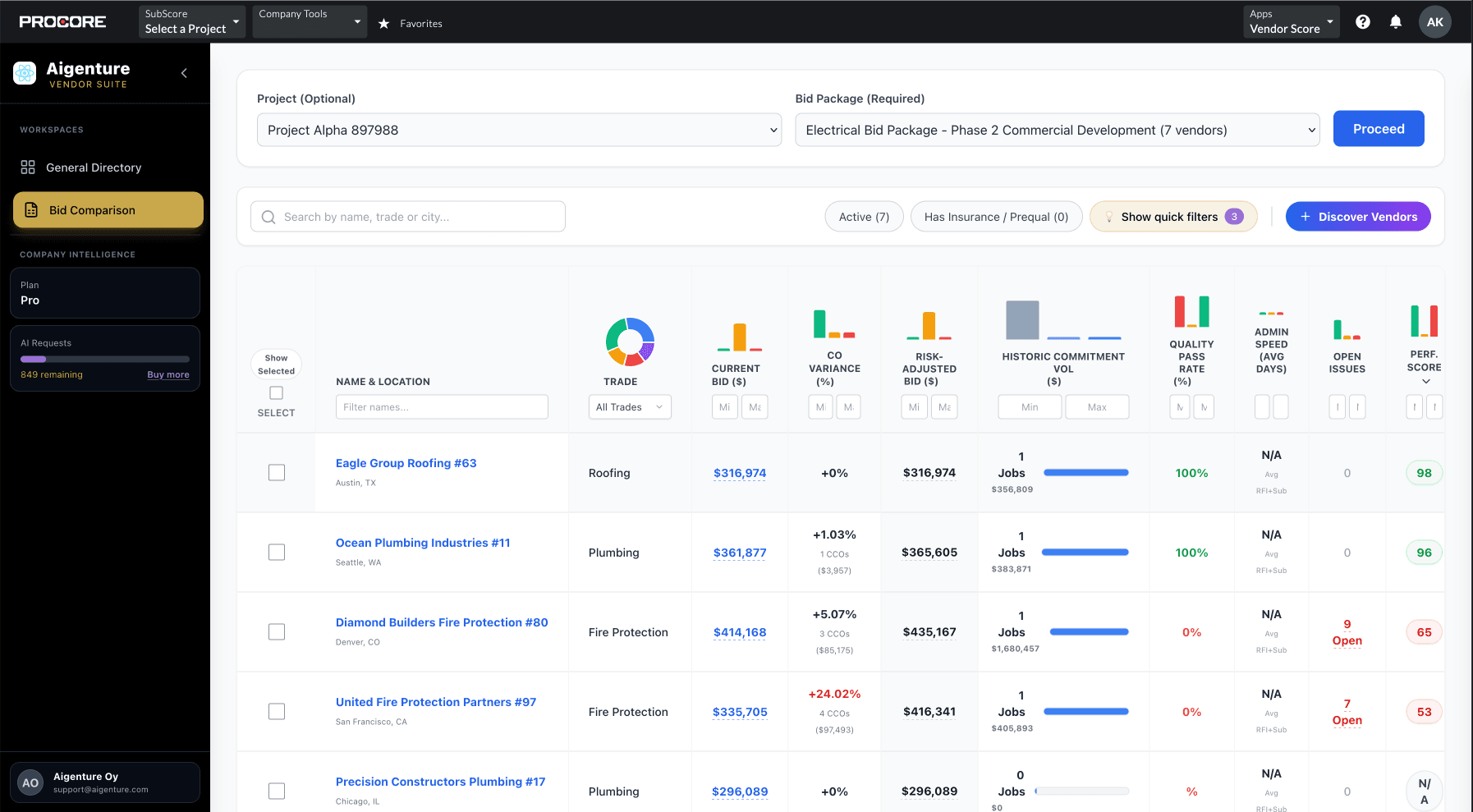
As a recent industry guide on ProjectMark highlights, "2026 non-negotiables" for bid management now include AI-assisted bid matching and seamless integration between estimating and project management stacks. Setting up your packages correctly from day one makes it much easier for these advanced tools to do their job.
Using AI to speed up bid evaluations
This is where the real time savings happen. Instead of manually extracting data, AI-powered tools like Aigenture can read subcontractor proposals and normalize them instantly.
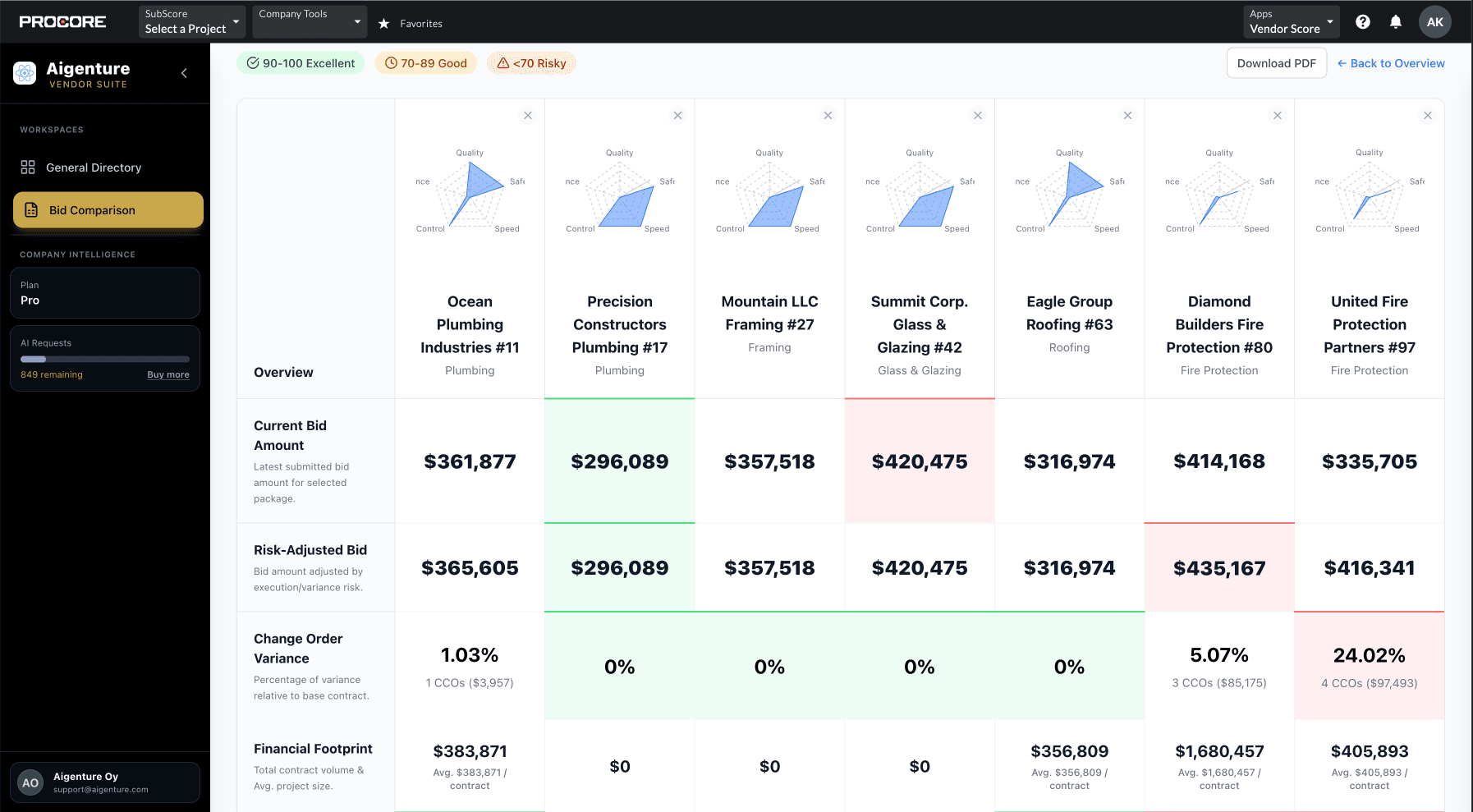
When you connect an AI layer to your Procore bid packages, the software can: 1. Extract line items: Automatically pull pricing from unstructured PDFs. 2. Spot scope gaps: Identify items that were requested in the bid package but are missing from the proposal. 3. Compare side-by-side: Generate a leveling sheet without a single minute of data entry.
For a deeper look at how this works, you can read our guide on How to Automate Bid Leveling in Procore.
Finding the right subcontractors with vendor intelligence
A fast award is useless if you hire the wrong partner. Bid management should include a layer of deep vendor intelligence. This means looking beyond the price and checking: * Financial stability: Can they handle the cash flow requirements of this project? * Safety records: Do they have a history of OSHA violations? * Capacity: How many other projects do they have active in Procore right now?
By using Procore Bid Insights, you can see which subcontractors are consistently reliable and which ones tend to hit you with change orders halfway through the job.
Connecting preconstruction to the field
The final step in modern bid management is closing the loop between the office and the job site. Most estimators never see the final results of the subcontractors they hire.
By pulling historical field data—like inspection pass rates and manpower logs—directly into the bidding process, you can avoid risky vendors. If a subcontractor has a 40% failure rate on quality inspections on their last three jobs, you probably shouldn't award them the next one, even if they are the low bidder.
Conclusion: Faster decisions, lower risk
Procore bid management has evolved from a simple document storage system into a powerful decision engine. By standardizing your workflow and adding an AI layer for bid leveling and vendor intelligence, you can cut your evaluation time by 90%. This allows your preconstruction team to focus on strategy and risk mitigation rather than data entry.
Aigenture lives natively inside Procore to help you compare bids 10x faster and spot hidden risks before you award a contract. If you are ready to move beyond manual spreadsheets, start a 30-day free trial today.
References
- Turskis, Z., et al. (2019). "A Multi-Criteria Decision-Making Model for Subcontractor Selection." Journal of Civil Engineering and Management.
- "Best Construction Bid Software in 2026: Honest Comparison." ProjectMark.
- "About Bid Management Enhanced Experience." Procore Support.